Jenny & Ketty's blog: One stop for Pop Culture, Reviews on Movies, Books, Dramas, Anime & Manga & much more ^_^
Showing posts with label space. Show all posts
7 May 2012
Super moon photos may 2012
Labels
2012,
may,
photos,
planet earth,
space,
Super moon
6 May 2012
Bright moon near bright star Antares on May 6
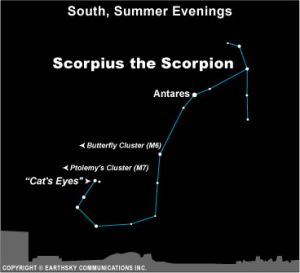
Wow. Who knew a supermoon could be so exciting? Thanks for everyone who posted their great images from around the world on EarthSky’s Facebook page, and for all your wonderful comments and observations. Tonight’s moon – May 6, 2012 – will still look full, but it’s really a waning gibbous moon that lights the sky. You’ll find tonight’s moon near a bright star, red Antares in the constellation Scorpius, sometimes called the Heart of the Scorpion.
What time will the waning moon rise? The exact time depends on your location on the globe, and you can find some recommendations for sky almanacs here. For most of us, though, the moon will rise tonight as darkness is falling across your part of Earth. If your horizon is cluttered with trees, buildings or other obstacles, you’ll have to wait a few to several hours after sunset for the brilliant moon to rise higher in the sky.
Once you have the moon well in sight, say around 10 to 11 p.m. this evening (your local time), look below it for a nearby bright star. Tonight the moon appears on the sky’s dome near bright Antares, the ruddy Heart of the constellation Scorpius the Scorpion. Antares is a red supergiant star. It’s red because its outer layers are cool – at least cooler in contrast to other stars. Although it appears as a mere pinpoint of light in our night sky, Antares is so large that if it were to take the place of our sun, its outer layers would extend beyond the orbit of Mars.
By summer, Antares will be prominently placed in the early evening sky. If you have a darker sky, with no moon, you'll easily see its constellation, which features a pattern reminiscent of a real scorpion's curved tail.
Antares’ red color might be hard to discern on May 6, 2012 next to the spotlight of the big and brilliant moon. So note this star’s location tonight in the east in the evening. And notice the pattern of stars around it. Then come back to this star when the moon has moved away, and you’ll clearly see how red it is – and how fiercely it twinkles when it’s low in the sky.
Antares is known for twinkling madly and displaying glints of other colors. When a star lies low in the sky, we see it through much more air than when the star is closer to overhead. Earth’s atmosphere is what causes stars to twinkle, so stars seen low in the sky – like Antares in the evening now – twinkle more fiercely.
Bottom line: Use the moon to find Antares, the Heart of the Scorpion in the constellation Scorpius, on May 6, 2012. After the excitement over last night’s full supermoon, the moon is now waning. But it’ll still look round and full in your night sky, and it’ll be beautiful near this star.
Labels
2012,
Bright moon,
bright star Antares,
May 6,
planet earth,
space
20 Sept 2011
24 Jun 2011
New solar system found!
NASA's Kepler space telescope has picked up multiple planets in a system with a star much like the sun, the largest group of transiting planets yet discovered.
The system is very different from the one we call home. The star, about 2,000 light years away, is very much like the sun, but the planets around are in fast, tight orbits. One takes as little as ten days. Five of the six are closer to their sun than Mercury is to ours.
Many of the solar systems discovered have been the homes of Jupiter-sized planets in eccentric orbits. Those types of systems are much easier to see, because a big planet's effects on the parent star are more visible. Kepler is designed to seek out planets closer in size and mass to Earth.
In this case, Kepler found six planets, all of them transiting the face of the star, called Kepler-11. The planets, in order of their distance from the star, are Kepler-11b, 11c, 11d, 11e, 11f and 11g. Kepler 11b is at about 9 million miles from its sun. The outermost one is on the order of 45 million miles out.
Labels
new solar system,
planet earth,
space
Space explorations keeps us closer and safer on earth
The Coalition for Space Exploration, a collective of many prominent, established aerospace firms has released the second part of its “Think Outside the Circle” campaign that highlights the positive influence of space exploration on our everyday lives.
The latest installment is called “Closer and Safer” and discusses how how space-based technology has improved the quality of living of so many down here on Earth, helping out in cases of emergency like fires and hurricanes and in more personal matters like eye surgery.
The release of this public service announcement coincided with the final launch of space shuttle Endeavour which took place on May 16. The campaign’s purpose is to garner support among the general population as well as the U.S. leadership.
“We enjoy a myriad of real benefits each day as a result of space exploration,” said Coalition Chairman Glenn Mahone. “Our intention is to not only inform viewers about these benefits, but cause them to think in new ways – outside the circle of Earth – and ask, ‘What’s next? What would our lives be like without these technologies?”
Labels
planet earth,
space
Why NASA chose potentially threatening Asteroid for New Mission
An artist's interpretation of NASA's asteroid-sample mission OSIRIS-REx, which will rendezvous with the near-Earth asteroid designated 1999 RQ36 in 2020. The mission is expected to launch in 2016.
When it comes to visiting asteroids, NASA doesn't pick run-of-the-mill space rocks. The target of NASA's latest asteroid mission is not only thought to be rich in the building blocks of life, it also has a chance — although a remote one — of threatening Earth in the year 2182.
The asteroid 1999 RQ36 is the target of a new unmanned spacecraft, which NASA plans to launch in 2016 to collect a sample from the space rock and return it to Earth by 2023.
The mission's leaders spent a long time surveying possible destinations for the mission, and finally settled on 1999 RQ36. NASA calls the mission OSIRIS-Rex, which is short for Origins-Spectral Interpretation-Resource Identification-Security-Regolith Explorer.
"We went through a whole series of selection criteria," OSIRIS-Rex's deputy principal investigator Dante Lauretta, a planetary scientist at the University of Arizona, told SPACE.com. "There are over 500,000 asteroids known. [1999 RQ36] looks really optimum." [Video: The OSIRIS-Rex Mission to 1999 RQ36]
A Potentially Dangerous Asteroid:
In addition to digging up clues about our solar system's history, the OSIRIS-Rex mission may be able to help Earth fend off potentially deadly space rocks. That's because asteroid 1999 RQ36 — which is about 1,900 feet (580 meters) wide — is public enemy No. 1 for space rock scientists.
"1999 RQ36 has the highest probability of impacting the Earth of any known Potentially Hazardous Asteroid," according to a mission proposal submitted to NASA by the OSIRIS-Rex in 2009.
Infographic: How the OSIRIS REx Asteroid sample return Mission will work?
A recent calculation found that the asteroid has a 1-in-1,800 chance of hitting Earth in the year 2170, and a 1-in-1,000 chanceof slamming into us in 2182.
While those are slim odds, they put 1999 RQ36 at the top of the danger list.
"I wouldn't go buy asteroid insurance," Lauretta said. "We're OK for 150 years or so. We're not saving the Earth from immediate danger."
Still, he said studying the asteroid and its orbit up close could help us better predict the risk, and outline a strategy to protect ourselves if necessary. [Photos: Asteroids in Deep Space]
Artist's concept of anchoring to the surface of an asteroid
One reason the likelihood of Earth impact can't be better predicted is because scientists don't fully understand the Yarkovsky effect, which causes asteroids to accelerate slightly when they absorb sunlight and then re-emit it as heat.
"[1999 RQ36's] orbit is currently well known because of optical and radar data but the long-term motion is less well understood because of the poorly defined Yarkovsky effect," said Donald Yeomans, manager of NASA's Near-Earth Object Program Office, who is not directly involved with the OSIRIS-Rex mission. "This mission should allow a much better understanding of these effects once the asteroid's size, mass, rotation characteristics and thermal properties are studied."
Target: Asteroid 1999 RQ36:
One of the most attractive features of asteroid 1999 RQ36 for scientists is its size: It is as large as five football fields, which means it won't be spinning too fast when OSIRIS-Rex approaches. The asteroid should also have a large supply of lose dirt, or regolith, on its surface for easy sampling.
1999 RQ36 is thought to be carbonaceous, or rich in carbon and organic material, and likely to contain some of the building blocks of life, such as the amino acids used to build the proteins vital to life on Earth.
"We cannot tell from telescopes exactly what kind of material, but we believe it's the sort of stuff that came in through the Earth's atmosphere after liquid oceans first formed, perhaps by 4.45 billion years ago, and provided those building blocks," said OSIRIS-Rex principal investigator Mike Drake of the University of Arizona, during a news conference yesterday (May 25).
In fact, the asteroid is a primitive B-class carbonaceous asteroid, a class that has never been studied up close by a spacecraft before, and should provide an unprecedented opportunity to learn about the history of the solar system and the origin of life on Earth.
The material inside 1999 RQ36 is thought to date to the very formation of our solar system around 4.56 billion years ago. While the space rock now orbits relatively near Earth — making it a convenient target for visiting — scientists think it is a fragment of an even larger asteroid that collided with another rock in the main asteroid belt between Mars and Jupiter, a few million years ago.
Building on asteroid successes:
The OSIRIS-Rex mission is not NASA's first mission to an asteroid, but it will be the first U.S. probe to retrieve samples and return them to Earth. Only Japan's Hayabusa spacecraft, which returned samples of the asteroid Itokawa to Earth in June 2010 after a seven-year journey, has performed a similar feat.
NASA has sent probes to visit asteroids before. The agency's NEAR spacecraft rendezvoused with the asteroid Eros and ultimately touched down on that space rock at the end of its mission in February 2001.
NASA's Dawn probe, meanwhile, is nearing the asteroid Vesta — the second-largest space rock in the asteroid belt. Dawn will orbit Vesta for many months, then head off to visit Ceres, the largest asteroid in the solar system.
But the NEAR and Dawn missions are only visiting asteroids. OSIRIS-Rex will bring pieces back home. And that has scientists brimming with anticipation.
"Asteroid 1999 RQ36 is a perfect target for sample return and I can't wait to see the exciting results from both the in situ science activities and the sample return analysis," Yeomans said.
Labels
NASA,
planet earth,
space
Giant “Surfing” Waves Roll Through Sun’s Amosphere
Surfer waves -- initiated in the sun, as they are in the water, by a process called a Kelvin-Helmholtz instability -- have been found in the sun's atmosphere. Credit: NASA/SDO/Astrophysical Journal Letters
Surf’s up on the Sun! Our favorite gnarly spacecraft, the Solar Dynamics Observatory (SDO) has caught conclusive evidence of classic “surfer waves” in the Sun’s atmosphere. But these waves trump ‘Hawaii Five-O’ surfing big time, as they are about the same size as the continental U.S. Spotting these waves will help our understanding of how energy moves through the solar atmosphere, known as the corona and maybe even help solar physicists be able to predict events like Coronal Mass Ejections.
“One of the biggest questions about the solar corona is the heating mechanism,” says solar physicist Leon Ofman of NASA’s Goddard Space Flight Center, Greenbelt, Md. and Catholic University, Washington. “The corona is a thousand times hotter than the sun’s visible surface, but what heats it up is not well-understood. People have suggested that waves like this might cause turbulence which cause heating, but now we have direct evidence of Kelvin-Helmholtz waves.”
Even though these waves occur frequently in nature here on Earth, no one had seen them on the Sun. But that was before SDO.
Ofman and colleagues spotted these waves in images taken on April 8, 2010 in some of the first images caught on camera by SDO, which launched in Feburary last year and began capturing data on March 24, 2010. Ofman & team have just published a paper in Astrophysical Journal Letters.
Kelvin-Helmholtz instabilities occur when two fluids of different densities or speeds flow by each other. In the case of ocean waves, that’s the dense water and the lighter air. As they flow past each other, slight ripples can be quickly amplified into the giant waves loved by surfers. In the case of the solar atmosphere, which is made of a very hot and electrically charged gas called plasma, the two flows come from an expanse of plasma erupting off the sun’s surface as it passes by plasma that is not erupting. The difference in flow speeds and densities across this boundary sparks the instability that builds into the waves.
On the sun, the two fluids are both plasmas — expanses of super hot, charged gases — which interact. One is erupting from the surface and shooting past a second plasma that is not erupting. The resulting turbulence is a Kelvin-Helmholtz wave form.
The erupting plasma is likely from a Coronal Mass Ejection, such as was seen earlier this week, where the Sun violently propels massive amounts of high-speed plasma particles into space. So, knowing more about the how the corona is heated and what the conditions are just before the KH waves form might give scientists the ability to predict a the next CME, which is a long-standing goal of solar scientists.
But figuring out the exact mechanism for heating the corona will likely keep solar physicists busy for quite some time. However, SDO’s ability to capture images of the entire sun every 12 seconds with such precise detail will certainly provide the data needed.
Labels
save earth,
space,
sun surfing waves
16 Jun 2011
Scientists see sunspot "hibernation" but no Ice Age
Sunspot cycles -- those 11-year patterns when dark dots appear on the solar surface -- may be delayed or even go into "hibernation" for a while, a U.S. scientist said on Wednesday.
But contrary to some media reports, this does not mean a new Ice Age is coming, Frank Hill of the National Solar Observatory said in a telephone interview.
"We have not predicted a Little Ice Age," Hill said, speaking from an astronomical meeting in New Mexico. "We have predicted something going on with the Sun."
The appearance of sunspots helps predict solar storms that can interfere with satellite communications and power grids.
Hill and other scientists cited a missing jet stream, fading spots and slower activity near the Sun's poles as signs that our nearest star is heading into a rest period.
"This is highly unusual and unexpected," he said in a statement released on Tuesday. "But the fact that three completely different views of the Sun point in the same direction is a powerful indicator that the sunspot cycle may be going into hibernation."
That hibernation would not begin now, as the current sunspot cycle, the 24th, has recently passed its minimum. Hill and his colleagues pondered a slowdown in sunspot activity in the 25th cycle, expected sometime around 2019.
They also wondered whether this possible slowdown, or even a long cessation of sunspot activity, indicates an upcoming return of the Maunder Minimum, a 70-year sunspot drought seen from 1645-1715.
Labels
planet earth,
space,
sun spot
15 Jun 2011
Longest and darkest total lunar eclipse of century tonight!!!!!
Dont miss it.....cuz its not possible to wait 100 years right?
The longest and darkest total lunar eclipse of the century will occur tonight, giving sky enthusiasts all over the country an opportunity to witness the event.
An unusually long lunar eclipse with the Moon immersed deeply inside the umbral (darker) shadow of the Earth will occur tonight, Nehru Planetarium Director N Rathnasree said.
"The total phase of this lunar eclipse will last 100 minutes. The last eclipse to exceed this duration was in July 2000," she said.
The next such eclipse will only take place in 2141.
The total lunar eclipse will begin at 00:52:30 IST and end at 02:32:42 IST. While the partial eclipse will begin at 23:52:56 IST and end at 03:32:15 IST.
The eclipse will be visible completely in Africa and Central Asia. It will be visible rising over South America, Western Africa and Europe, and seen setting over Eastern Asia, and Australia, C B Devgun from Science Popularisation Association of Communicators and Educators (SPACE) said.
The magnitude of the one of the relatively rare total lunar eclipse will be 1.70 magnitude, N Sri Raghunandan Kumar of Planetary Society of India said.
The next lunar eclipse to be viewed in India will be in December this year.
Also, a star named 51 Ophiuchi will be occulted during the eclipse.
Sky enthusiasts can witness the whole sequence of the occultation in the zodiacal constellation of Ophiuchus.
At 11:29 PM tomorrow, the Moon will occult (hide) behind the star 51 Ophiuchi. The star will reappear after 90 minutes at 01:01 AM of June 16, Kumar said.
Labels
eclipse,
longest eclipse,
planet earth,
space
1 Jun 2011
Triple eclipse to be seen in a month!
New Delhi, May 31 (PTI) A triple eclipse treat -- two partial solar and one total lunar eclipse in a month beginning from tomorrow, is in store for sky gazers.
The first of the three, which will be a partial solar eclipse will be seen on June 1.
The eclipse, however, will not be visible from India.
It will be visible from high latitudes in the Northern hemisphere, starting at sunrise time over Siberiaand Northern China, Alaska, Nova Scotia. In fact, the eclipse begins at 00 55 18 IST on June 2.
Eclipse chasers in the country should not be a disheartened lot as a total lunar eclipse will be visible on June 15.
The eclipse will be visible from the Indian region, Middle East, East Africa, South America, Australia.
During the lunar eclipse the moon will be completely covered by Earth''s shadow from 11.52 PM on June 15 to 2.32 AM on June 16.
The last of the triple eclipse will be another partial solar eclipse on July 1.
It is the first of the two total lunar eclipses in 2011, the second occurring on December 10. Earlier on January 4, a partial lunar eclipse was seen.
The last of the three eclipses is another partial solar eclipse.
This partial solar eclipse will also not be visible from India. It will be visible from southern latitudes, Antarctica. Its magnitude will be 0.097.
Labels
eclipse,
longest eclipse,
planet earth,
space
Subscribe to:
Posts (Atom)